
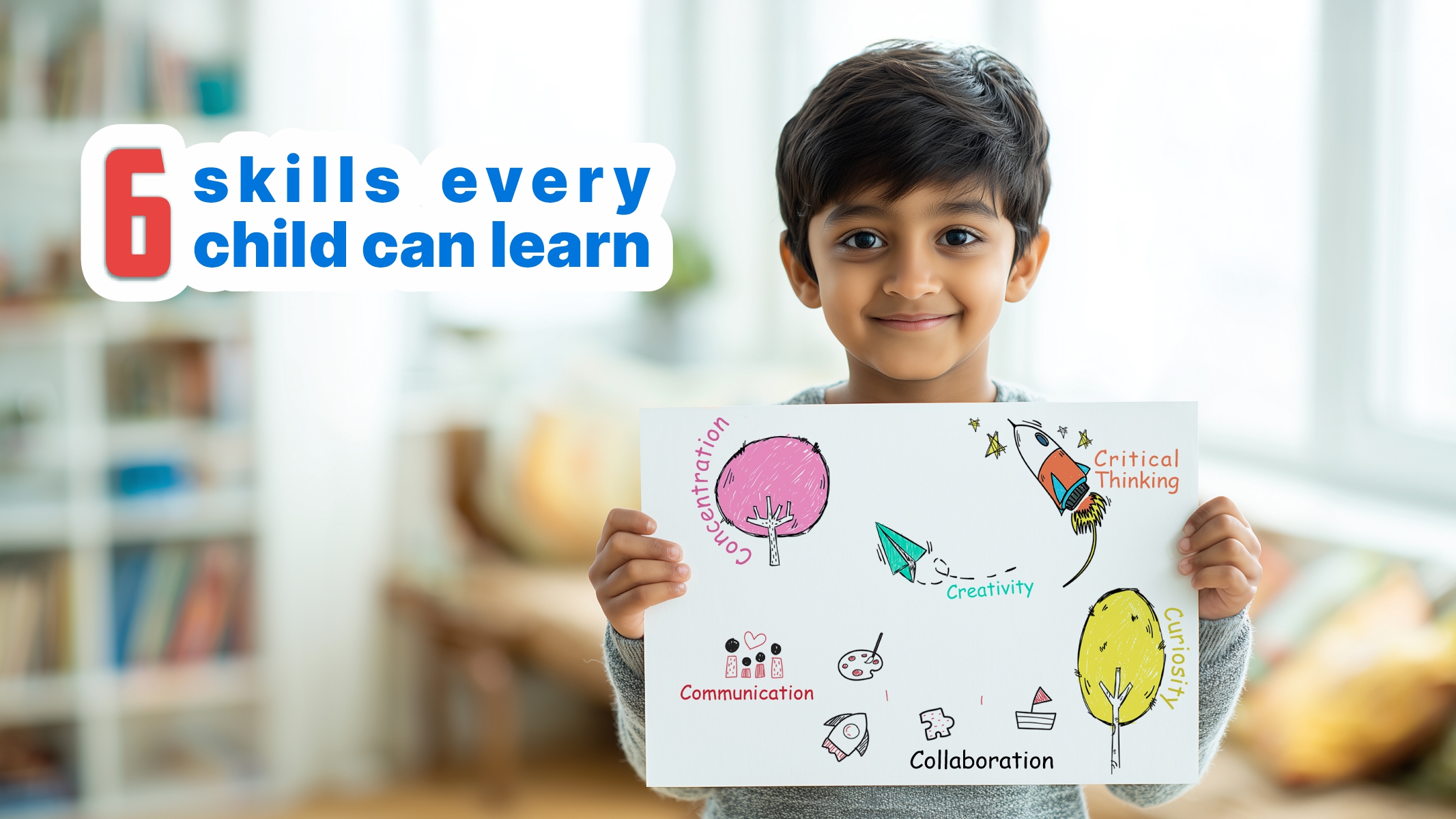
Every day offers new opportunities for growth, learning and discovery. Beyond academics, it is essential life skills such as creativity, critical thinking, communication, collaboration, concentration and curiosity that truly shape a child’s success. These abilities help children imagine, reason, express, connect, focus and explore with confidence.
Here is a roadmap for parents to guide children (from primary to senior classes) in nurturing these vital skills.
- Creativity
Creativity allows children to think beyond limits, express themselves freely and find new solutions to challenges. It is closely linked to emotional intelligence, as it helps children recognise, express, and channel their emotions in healthy, imaginative ways while developing empathy, resilience and innovative problem-solving.Studies in Frontiers in Psychology and the Harvard Graduate School of Education identify creativity in children as a vital 21st-century skill that strengthens flexible thinking, resilience and imagination.
Practical ways to develop it at home:
- Encourage art, crafts or storytelling.
- Let children design Rangoli patterns or make eco-friendly decorations.
- Use open-ended creative projects that promote creative learning ideas and joyful expression.
2. Critical Thinking
Critical thinking helps children analyse, question and evaluate information rather than accept it at face value, encouraging logical reasoning and sound judgement.
Studies from Atlantis Press and MDPI (Multidisciplinary Digital Publishing Institute) Education Sciences show that inquiry-based learning greatly improves reasoning skills, decision-making and problem-solving abilities in learners.
Practical ways to develop it at home:
- After reading a story or watching a film, ask “what if” or “why did they choose that” questions.
- Use puzzles, riddles or board games that encourage reasoning.
- Discuss real-world issues to enhance critical thinking in students through perspective-taking.
3. Communication
Strong communication skills enable children to express their thoughts clearly, listen empathetically and build meaningful connections while enhancing their confidence, personality, and social presence.
MDPI Education Sciences reports that effective communication in schools improves student engagement, academic outcomes and interpersonal skills.
Practical ways to develop it at home:
- Encourage children to read aloud or narrate stories in their own words.
- Hold family discussions or sessions to develop public speaking for kids.
- Promote role-play activities that nurture clarity, confidence and empathy.
4. Collaboration
Collaboration teaches teamwork, respect for others’ ideas and shared accountability, skills crucial for success in any community or workplace.
A study published in the Redalyc Journal of Educational Psychology found that collaborative learning enhances creativity, adaptability and social responsibility among children.
Practical ways to develop it at home:
- Involve children in team-based activities through group projects, science experiments or community initiatives.
- Assign roles such as leader, organiser or creator to build ownership.
- Reflect together on what went well and what could improve, encouraging shared growth.
5. Concentration
Concentration forms the bedrock of effective learning. In today’s digital age, cultivating focus helps children build mental discipline, patience and productivity.
According to Harvard University’s Center on the Developing Child, regular focus-based activities strengthen the brain’s executive functions, improving attention and memory retention.
Practical ways to develop it at home:
- Create screen-free zones for reading, puzzles or mindful crafts.
- Schedule 10–15 minutes of daily reading and gradually increase the duration.
- Use quiet and comfortable reading corners to boost focus building activities and mindfulness.
6. Curiosity
Curiosity inspires exploration and discovery, turning learning into an exciting self-driven experience that builds intrinsic motivation.
A Nature Human Behaviour (2022) study revealed that curiosity in children promotes memory retention, long-term engagement and a passion for learning.
Practical ways to develop it at home:
- Maintain a question jar where children can submit what they wish to learn about.
- Encourage inquiry learning for kids through hands-on science experiments or museum visits.
- Support self-directed reading on topics that spark wonder and imagination.
Developing these six skills, creativity, critical thinking, communication, collaboration, concentration and curiosity, builds confident and capable learners.
At Narayana Schools, dedicated soft skills programmes, nSports for physical and team-based development, Yoga Veekshan for mindfulness and holistic well-being, and Art Integration to nurture creativity and emotional expression ensure holistic growth. Every skill learned is a step towards realising dreams. Through engaging reading programmes, skill-based activities and experiential learning, students are guided to imagine, express, excel and achieve their dreams, because at Narayana Schools, your dreams are our dreams.
Is there any evidence of slant or particular angle presented in the article? Explain. Thank you, Regard
I really appreciate how this post highlights the importance of life skills like creativity and curiosity alongside academics. It’s so true that these abilities help children adapt and thrive in an ever-changing world. Encouraging kids to think critically and express themselves creatively sets the stage for lifelong confidence and learning.
Thanks for sharing such valuable information. Your perspective is refreshing and has given me a lot to think about.
Love that the article highlights both soft skills like empathy and practical ones like time management—my kid’s been struggling with decision-making lately, so the tip about letting them pick small daily choices (like snacks or outfits) feels super doable, though I wonder how to scale it as they get older.
Super
Narayana best school in India
Thank you for this wonderful information. We will very thank full if you will star this soft skills program for our children. Thank you so much.
Fantastic post! Your insights and detailed explanations really helped deepen my understanding of this topic. Looking forward to more content like this.
Thanks for sharing such valuable information. Your perspective is refreshing and has given me a lot to think about.
Keep posting articles like this
Thanks for sharing such valuable information. Your perspective is refreshing and has given me a lot to think about.
Fantastic post! Your insights and detailed explanations really helped deepen my understanding of this topic. Looking forward to more content like this.