
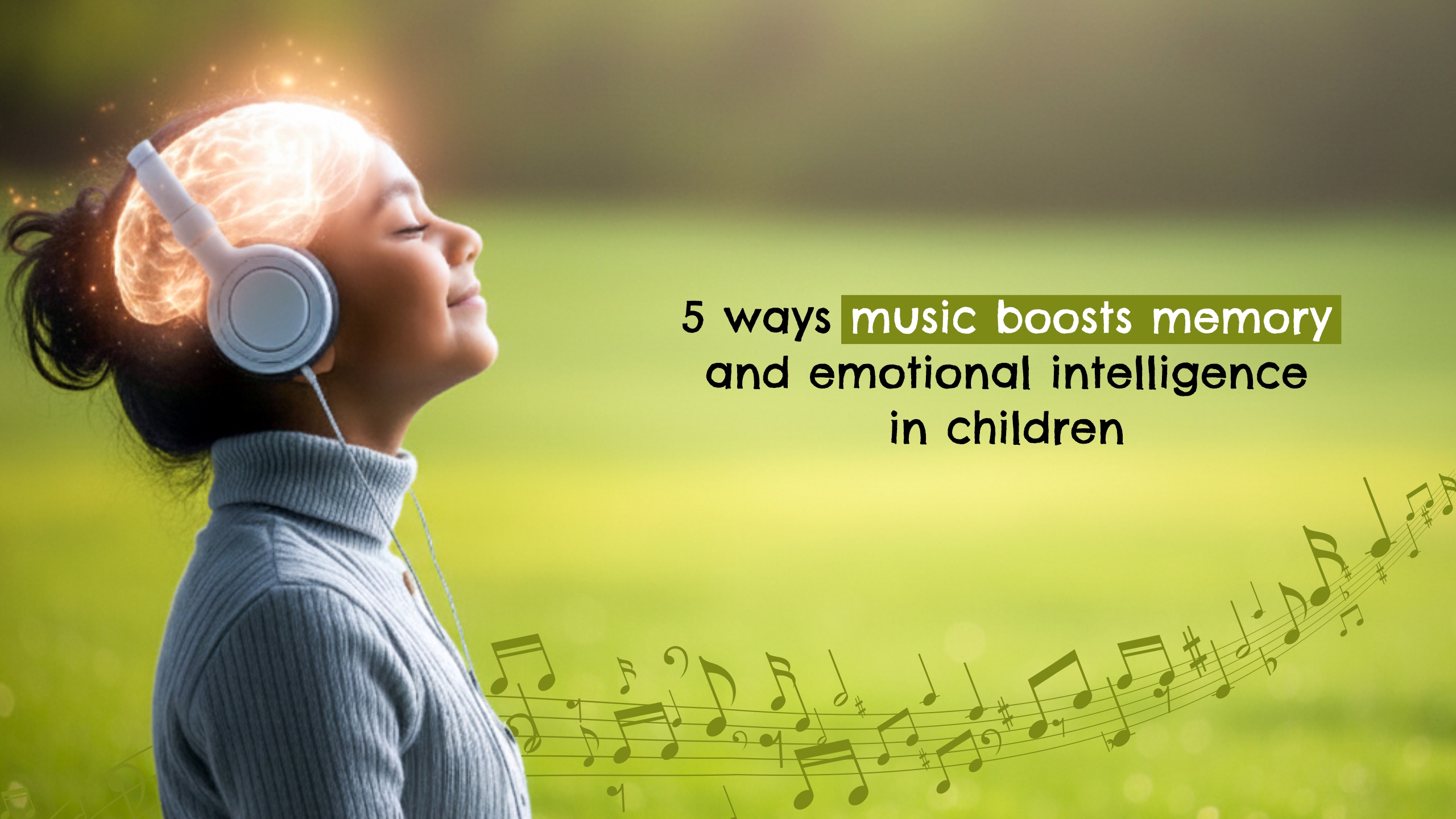
Music has long been known to inspire creativity and calm the mind, but recent studies reveal that it also plays a crucial role in shaping a child’s memory, emotional intelligence and cognitive development. Understanding how music impacts learning helps parents nurture well-rounded, emotionally balanced learners ready to thrive both in academics and life. Taking note of this connection is essential, as music can be one of the simplest yet most powerful tools to strengthen a child’s brain and heart together.
Here are 5 facts that are grounded in research and offer practical practices for parents:
| S.No. | Facts | Description | Accessible practices |
|
1 |
Music Enhances Working Memory | Research by the University of Helsinki (2014) found that children engaged in regular music practice demonstrated stronger working memory, that is, the ability to store and process short-term information. This improves problem-solving, reading comprehension and recall. | a. Encourage rhythm-based games like clapping sequences or drum beats.
b. Use rhythmic patterns to help memorise academic content like multiplication tables or spellings. c. Create short music breaks during study sessions to refresh focus. |
| 2 | Builds Emotional Awareness and Empathy | According to a 2018 University of Cambridge study, group musical activities improve emotional intelligence by helping children recognise emotions through tone, pitch, and rhythm. This leads to greater empathy and emotional regulation. | a. Discuss how different songs make one feel and identify the emotions each piece evokes (joy, calm, sadness, excitement).
b. Introduce children to diverse genres and cultural music traditions that express a wide range of emotions. c. Encourage participation in choir or group music sessions to build teamwork and empathy through shared rhythm and harmony. d. Use musical storytelling or songs with lyrical depth to help children understand emotional narratives and perspectives. |
| 3 | Strengthens Brain Connectivity | A Harvard Medical School study in 2020 revealed that children trained in music develop stronger neural connections between the auditory, motor, and prefrontal regions of the brain, enhancing cognitive flexibility and coordination. | a. Play background instrumental music during study time to improve attention and cognitive flow.
b. Encourage learning instruments such as the harmonium, tabla, flute, guitar, etc., to build coordination and discipline. c. Involve children in group music lessons to nurture cooperation, timing accuracy and sensory integration. |
| 4 | Boosts Concentration and Academic Performance | The National Institute of Health (NIH) reported that structured music education improves focus and discipline, leading to better academic outcomes. This correlation arises because learning and practising music strengthens neural pathways associated with attention, memory, and pattern recognition. Additionally, listening to classical or instrumental music helps regulate mood and reduce distractions, thereby enhancing attention span and study habits. | a. Replace screen time with a short period of active listening to complex pieces (such as a symphony or raga) to train auditory focus.
b. Create a playlist for different study moods, such as soothing for reading, upbeat for problem-solving, etc., to help structure study sessions naturally. c. Use memory-melody techniques, where facts, historical dates, or formulas are sung or set to rhythm, aiding long-term recall. |
| 5 | Reduces Stress and Promotes Emotional Balance | The American Psychological Association highlighted that music activates the brain’s reward system, reducing cortisol levels and fostering relaxation. Lower cortisol (the primary stress hormone) helps calm the nervous system, reduce anxiety and promote a sense of emotional balance. As a result, children experience improved focus, better decision-making and greater resilience in handling challenges. | a. Starting the day with uplifting tunes, like light classical, instrumental or devotional music helps set a calm and positive emotional tone for the hours ahead.
b. Encourage journaling after listening to music to help children reflect on how it makes them feel and enhance their emotional intelligence. c. Promote music as a healthy emotional outlet by motivating children to sing, hum or tap rhythms to ease built-up stress. |
Music not only refines intelligence but also nurtures emotional growth, helping children connect learning with joy, discipline and mindfulness. Studies by the Harvard University Centre for Music and the Brain and the University of Toronto’s Faculty of Music reveal that children exposed to structured music education develop enhanced cognitive flexibility, emotional regulation, and working memory. These abilities help them maintain focus and emotional balance even in the absence of musical cues, ensuring they do not feel dependent or handicapped when music is not present. Instead, they carry forward the discipline, rhythm and mindfulness learned through music into all areas of life.
At Narayana Schools, we understand the profound role music plays in holistic development, which is why we actively encourage students to listen, perform and participate in musical pursuits such as singing, choir and instrumental training, supported by state-of-the-art infrastructure and experienced mentors. Every rhythm of learning is harmonised with purpose, helping students reach closer to their dreams, because at Narayana Schools, your dreams are our dreams.
I love how this article highlights the cognitive benefits of music. It’s fascinating to see how something as simple as regular music practice can boost a child’s working memory. I’m curious, how do you think different genres of music might influence memory development?
hey testing this.
This answered all my questions. Very informative post!
This guide is so complete and easy to understand. Great work!
Really well explained and easy to follow. I’m bookmarking this.
Really well explained and easy to follow. I’m bookmarking this.
Excellent breakdown straightforward and super useful.